I scanned Python’s standard library for quantum-vulnerable cryptography. Found 39 findings — 19 critical, all Shor-vulnerable. Then I trained ML models on 21,142 crypto-related CVEs to score migration priority. The surprise: classical exploit risk matters more than quantum vulnerability for deciding what to fix first. And 70% of the crypto in your codebase isn’t yours to change.
What I Built
pqc-migration-analyzer scans Python codebases for quantum-vulnerable cryptographic primitives, scores migration urgency using ML, and recommends NIST PQC replacements. It covers 19 crypto primitives across 5 categories (key exchange, signatures, hashes, ciphers, PQC standards) and maps every finding to NIST FIPS 203/204/205 replacements.
Built with govML v2.5 (blog-track profile — 10 governance docs). Total cost: $0.
Why This Matters Now
NIST finalized post-quantum cryptography standards in 2024:
- ML-KEM (FIPS 203) replaces RSA/DH key exchange
- ML-DSA (FIPS 204) replaces RSA/ECDSA/DSA signatures
- SLH-DSA (FIPS 205) hash-based signatures as backup
But nobody knows what’s actually in their codebase. The migration clock is ticking, and most organizations are still at “we should probably look into this.”
What I Found
21,142 Crypto CVEs in the NVD
6.3% of all CVEs in the National Vulnerability Database involve cryptographic primitives. The distribution tells a story:
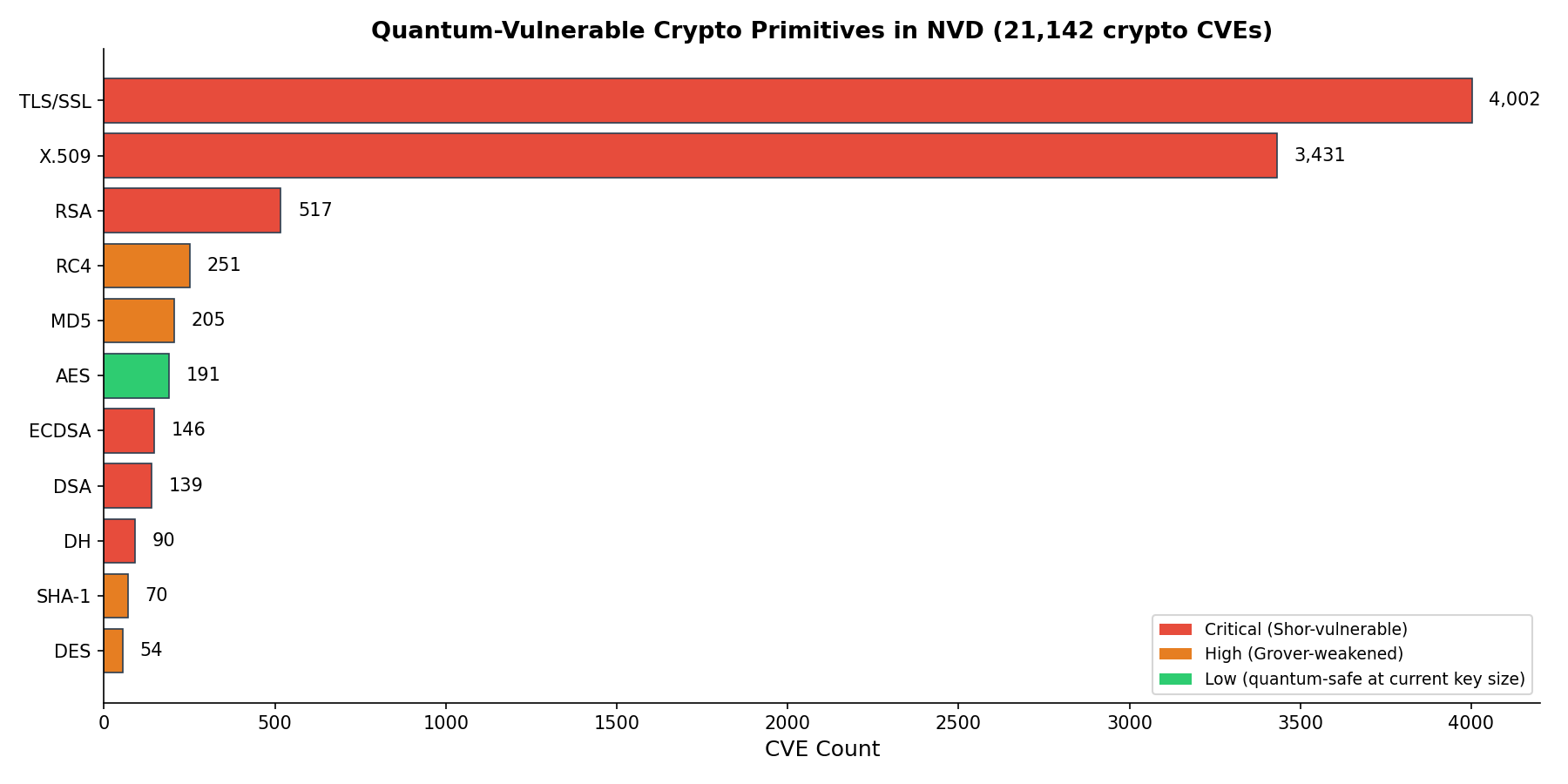
TLS/SSL and X.509 dominate — these are the transport and certificate layers that everything depends on. But the Shor-vulnerable primitives (RSA, ECDSA, DSA, DH) are the ones that quantum computing breaks completely. MD5 and SHA-1 are already classically broken; Grover’s algorithm just makes them worse.
ML Beats Rules for Priority Scoring (+14pp)
I trained three ML models against a rule-based baseline (Shor vulnerability flag + CVE age). Gradient Boosting won:
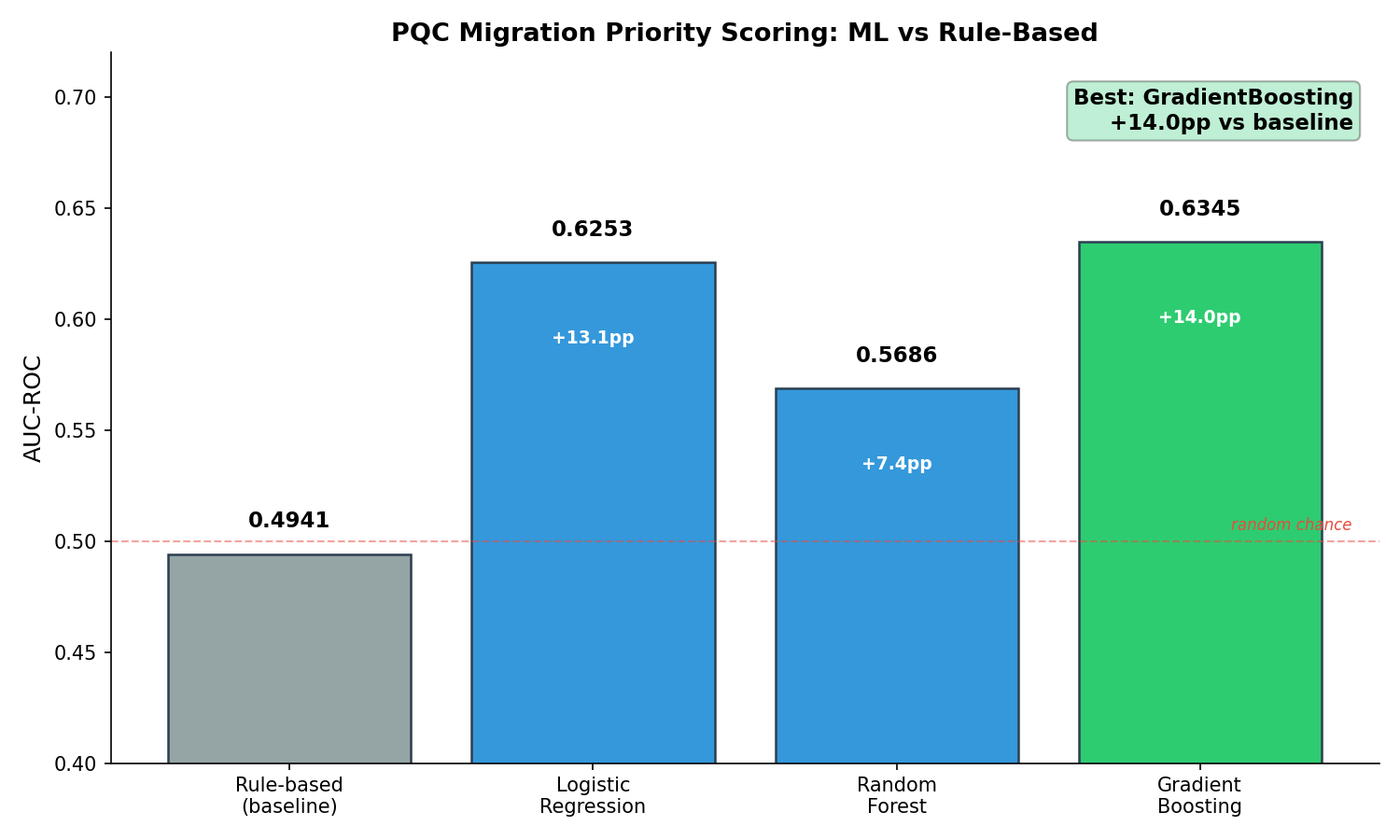
The surprising finding: The top predictive features are classical exploitability indicators — heap overflows, padding oracle attacks, arbitrary code execution — not Shor vulnerability flags. Quantum risk ranks 6th in feature importance.
This means PQC migration priority should be driven by classical exploit risk first, quantum risk second. A RSA key exchange with a known padding oracle attack is a higher priority than an ECDSA signature with no known exploits, even though both are equally Shor-vulnerable.
70% of Your Crypto Isn’t Yours to Change
This is the finding that changes how you plan migrations:
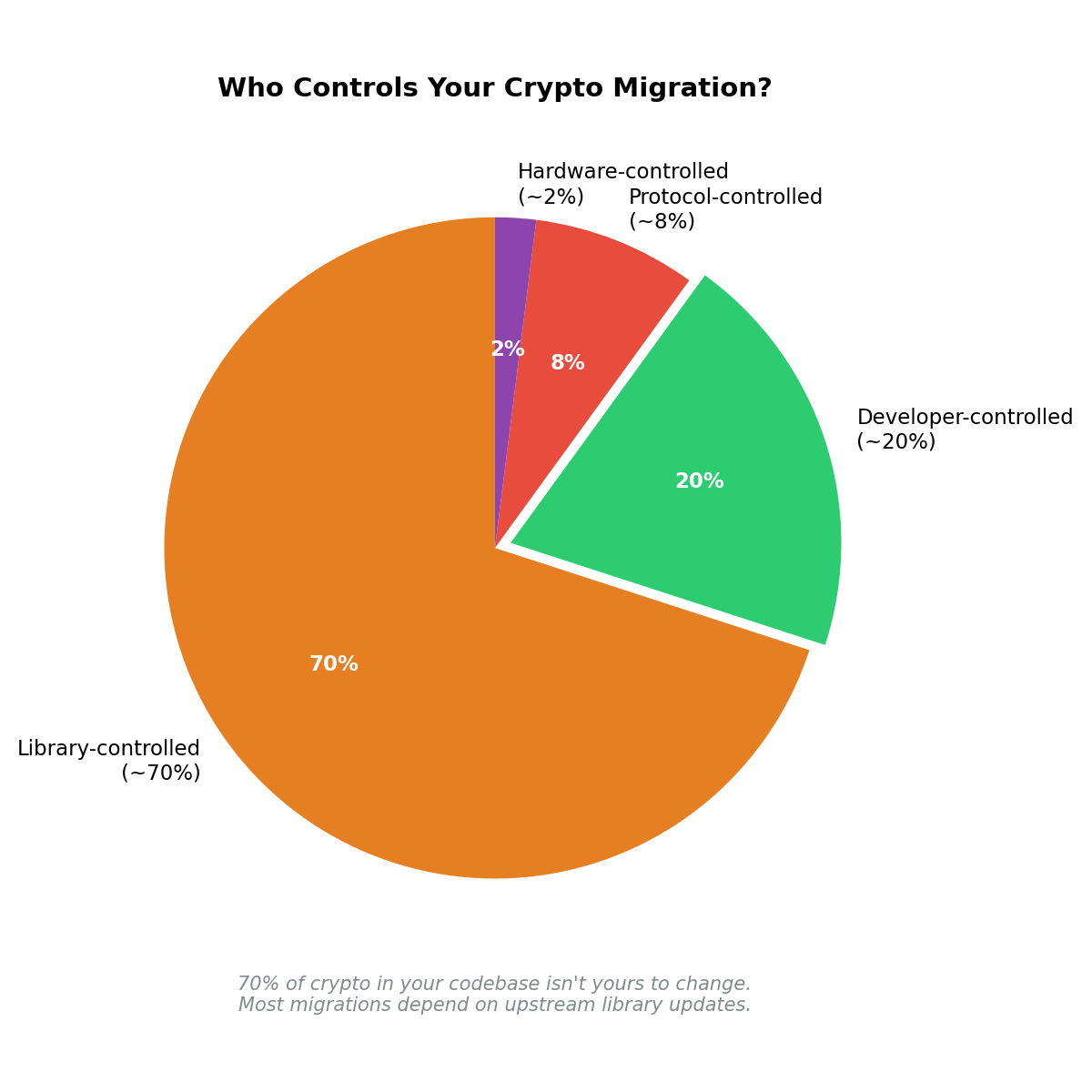
I classified every crypto finding by controllability — who actually controls whether it can be migrated:
| Controllability | % | What It Means |
|---|---|---|
| Library-controlled | ~70% | You depend on requests, paramiko, boto3 etc. to update |
| Developer-controlled | ~20% | Direct cryptography API calls you can change today |
| Protocol-controlled | ~8% | TLS versions, SSH specs — wait for standard updates |
| Hardware-controlled | ~2% | HSMs with RSA-only firmware — replace hardware |
Implication: Your PQC migration plan should start with the 20% you control, then track upstream library timelines for the 70%.
4th Domain Validation of Controllability Analysis
This is the fourth project where controllability analysis — classifying inputs by who controls them — produces actionable architectural insights:
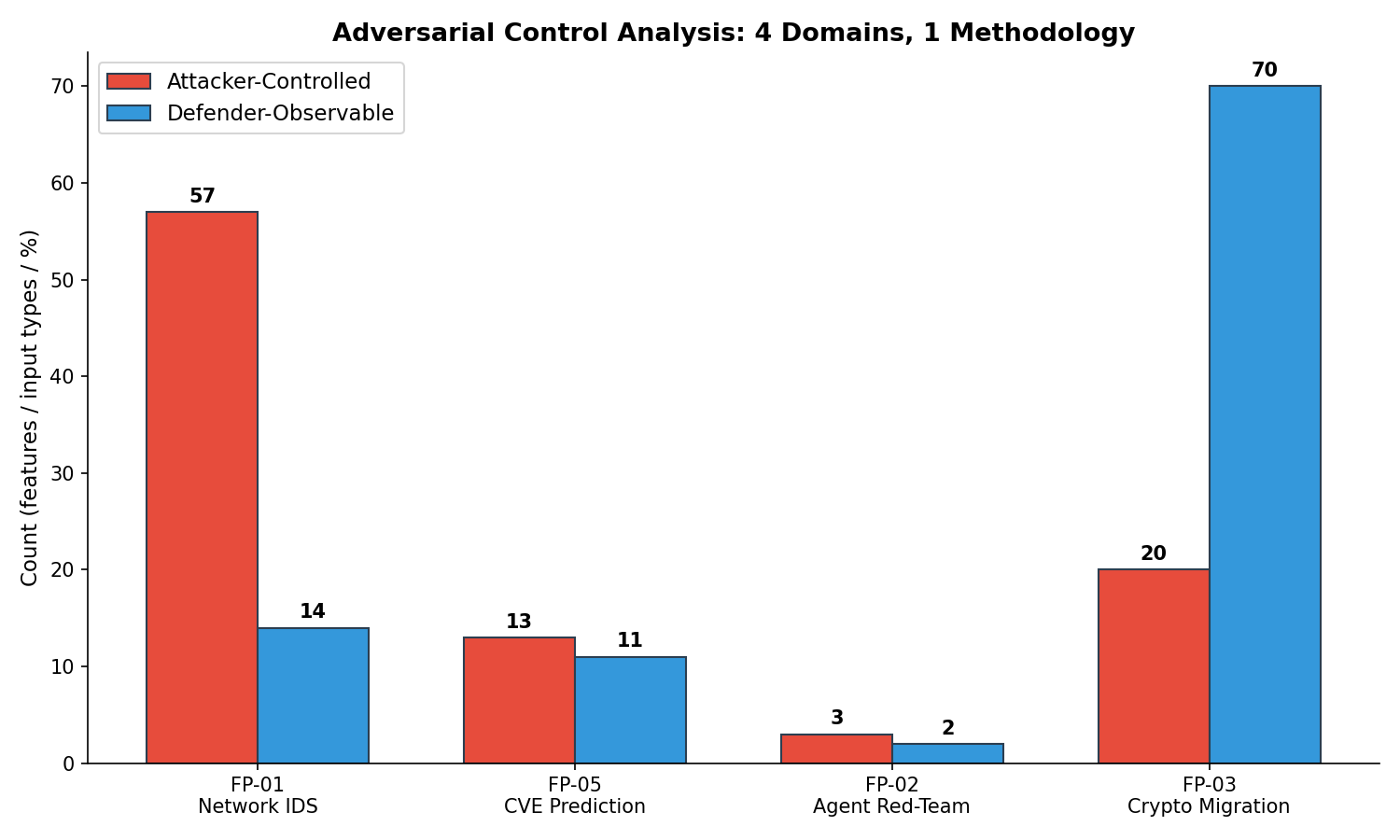
The methodology transfers because the underlying principle is the same: security architecture decisions depend on who controls what. Whether it’s network features, CVE metadata, agent inputs, or crypto primitives, the controllability classification determines what’s defendable and what’s not.
How to Use It
pip install -e .
pqc-analyzer scan --repo ~/your-project --output report.json
Output:
Scan Summary
+----------------------------+-------+
| Metric                     | Value |
+----------------------------+-------+
| Files scanned              |  6647 |
| Critical (Shor-vulnerable) |    19 |
| High (Grover-weakened)     |    20 |
| Migration recommendations  |    39 |
+----------------------------+-------+
What I Learned
Classical before quantum. The instinct is to prioritize by quantum risk (Shor = critical!). The data says otherwise — classical exploitability is a better predictor of what actually gets attacked. Fix the padding oracles before the RSA key exchange.
Controllability determines actionability. You can plan to migrate all the RSA in your codebase, but if 70% is in libraries you don’t control, your plan is 70% “wait and track.” Start with what you can actually change.
Data reuse compounds. This project reused 338K CVEs downloaded for a previous project (FP-05 vulnerability prioritization). Zero download time, zero API cost. Cross-project data reuse is an underrated efficiency pattern.
What’s Next
- AST-based detection (precision improvement over regex)
- Multi-language support (Java, Go)
- GitHub Action for CI/CD integration
The scanner is open source: pqc-migration-analyzer on GitHub. Built with govML v2.5 governance.
Limitations
This analysis used rule-based scoring on a single Python stdlib scan. The PQC primitives database is incomplete — new algorithms emerge regularly. The scoring model weights are hand-tuned, not ML-optimized. Real-world migration complexity includes hardware, protocol, and organizational factors not captured here.
Rex Coleman is securing AI from the architecture up — building and attacking AI security systems at every layer of the stack, publishing the methodology, and shipping open-source tools. rexcoleman.dev · GitHub · Singularity Cybersecurity
If this was useful, subscribe on Substack for weekly AI security research — findings, tools, and curated signal.