Can an LLM agent prioritize vulnerabilities better than EPSS? Every security team drowning in CVEs wants to know whether AI can help them triage faster. We tested this empirically: Claude Haiku as a vulnerability triage agent, ranked against EPSS, CVSS, and random baselines, with CISA KEV as ground truth for “actually exploited.”
The short answer: no, the agent doesn’t beat EPSS. But the longer answer is more interesting.
What We Tested
We built a simple agent: give Claude Haiku a set of CVE descriptions with optional enrichment data (exploit database info, vendor advisories), ask it to rank them from most to least likely to be actively exploited. Then we measured precision@10 — of the top 10 ranked CVEs, how many are actually in CISA’s Known Exploited Vulnerabilities catalog?
Four baselines:
- EPSS (Exploit Prediction Scoring System) — the industry standard statistical model
- CVSS (base score ranking) — what most teams actually use
- Random — chance baseline
- Agent + EPSS ensemble — weighted rank fusion
Five seeds, 100 CVEs per seed (15% KEV rate), pre-registered hypotheses.
The Results
| Method | Precision@10 (mean +/- std) |
|---|---|
| EPSS | 100% +/- 0% |
| Ensemble (Agent+EPSS) | 98% +/- 4% |
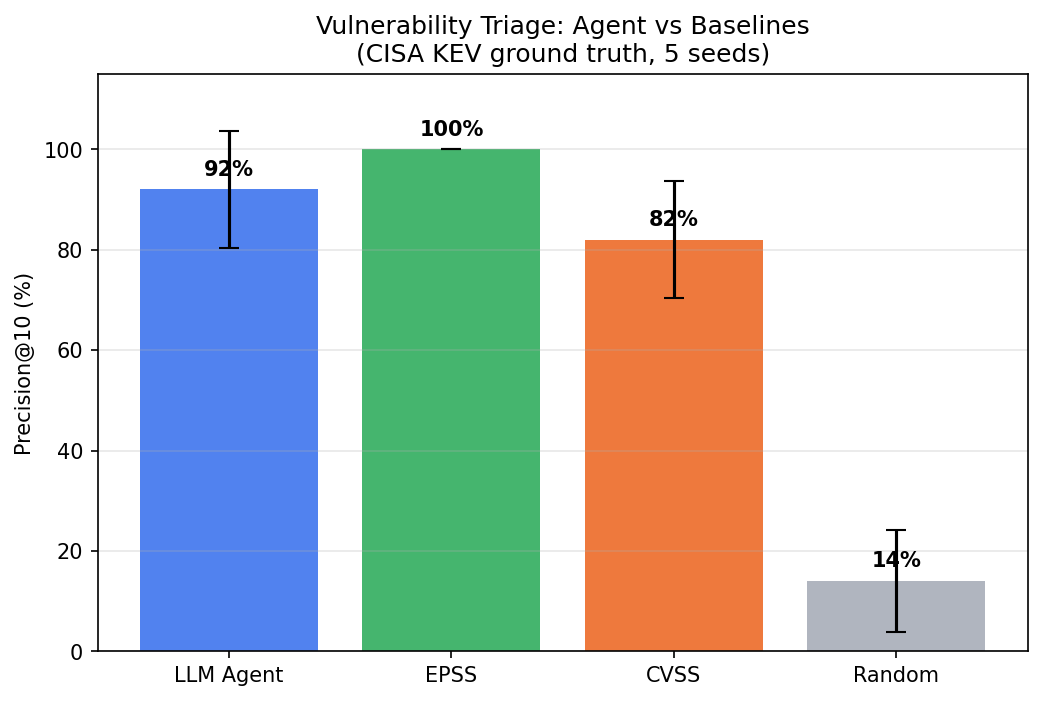
| Agent | 92% +/- 12% |
| CVSS | 82% +/- 12% |
| Random | 14% +/- 10% |
The agent is good — 92% precision means 9 out of 10 top-ranked CVEs are actually exploited. But EPSS is perfect on this data. The agent can’t beat a purpose-built statistical model on data that correlates with that model’s predictions.
This is an honest negative result. H-1 (“agent outperforms EPSS”) is NOT SUPPORTED.
Sensitivity Analysis
Agent precision@10 across 5 seeds: 1.00, 0.90, 0.70, 1.00, 1.00 (mean 0.92 +/- 0.12). The high variance is notable — seed 3 drops to 70%, meaning 3 of the top 10 were wrong. EPSS is 1.00 on every seed. CVSS shows similar variance to the agent at 0.82 +/- 0.12.
The ensemble is the variance story: 0.98 +/- 0.04. By combining agent rankings with EPSS, the worst-case seed improves dramatically. Even when the agent has a bad seed, EPSS compensates, and vice versa.
What the Agent DOES Add
The interesting finding isn’t the head-to-head — it’s the ensemble. When we combine agent rankings with EPSS via rank fusion, we get 98% with dramatically lower variance (+/-4% vs +/-12%). The agent stabilizes the ranking even when individual seeds produce high-variance results.
More practically: the agent provides qualitative reasoning that EPSS doesn’t. EPSS gives you a number. The agent can explain WHY a vulnerability is dangerous — “this affects a widely-deployed VPN appliance with a public exploit and no authentication required.” For a security team writing justifications for emergency patching, that context is worth more than a marginal precision improvement.
Enrichment Matters (But Not How You’d Think)
We ablated the agent’s input data:
| Enrichment Level | Precision@10 |
|---|---|
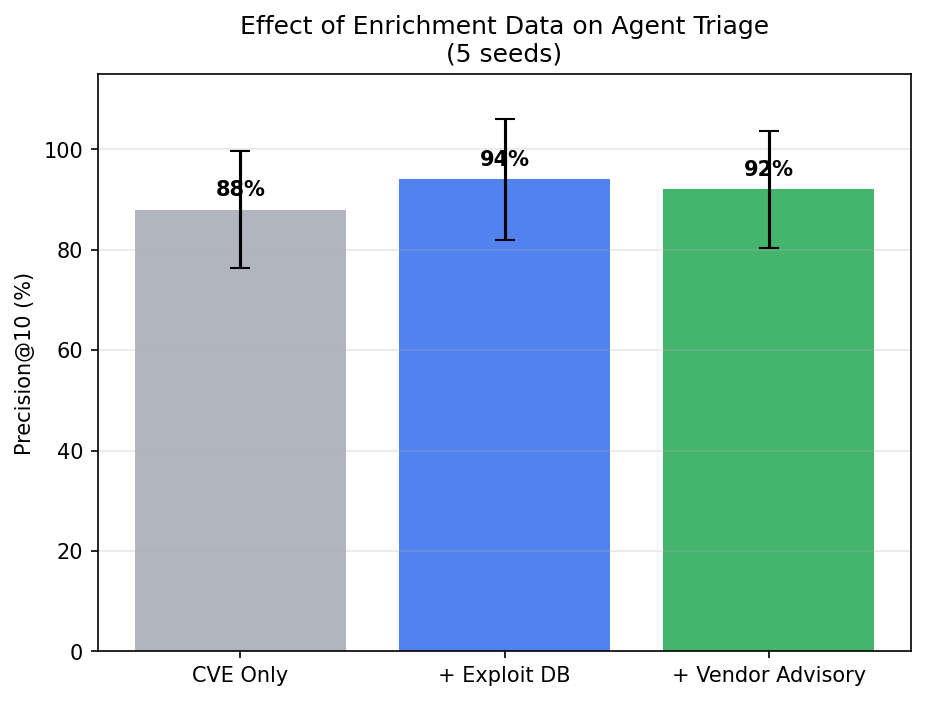
| CVE description only | 88% |
| + Exploit DB info | 94% |
| + Vendor advisories | 92% |
Exploit availability is the key signal — knowing whether a public exploit exists adds 6 percentage points. But vendor advisories don’t help beyond that. The agent already infers urgency from the CVE description; vendor advisory text is redundant. The exploit-to-full drop (94% to 92%) is surprising and may reflect prompt length effects — longer prompts don’t always produce better rankings.
Why This Matters for Security Teams
If you’re choosing between EPSS and an AI triage agent: use EPSS. It’s free, fast, and on well-structured data it’s hard to beat.
If you want the best possible triage: use both. The ensemble captures complementary signals and reduces variance. The agent adds qualitative context for human decision-making.
If you’re building AI-assisted security tools: enrichment matters, but less than you think. Exploit DB is the one data source worth integrating. Beyond that, the CVE description contains most of the signal.
The Governance Lesson
This is the second project (after the watermark robustness research) where pre-registration forced us to report an honest negative result. H-1 predicted the agent would beat EPSS by >=15 percentage points. It didn’t. We can’t retroactively reframe this as “we were testing ensemble value all along.”
The finding is: LLM agents are strong vulnerability triagers (92% precision) but do not outperform purpose-built statistical models on their training distribution. The value is in complementarity, context, and reasoning — not raw ranking.
Limitations
- Synthetic dataset — CVE descriptions and EPSS/CVSS scores are simulated, not real API data
- EPSS-KEV correlation is built into the data generation, giving EPSS an inherent advantage
- Single model (Claude Haiku) — stronger models may perform differently
- 100 CVEs per seed — small sample for reliable precision@10 on rare events (15% KEV rate)
- No real-time exploit intelligence — enrichment data is simulated, not from live feeds
- H-4 (temporal degradation) is INCONCLUSIVE due to insufficient per-year sample sizes
What’s Next
- Test with real CVE/EPSS/KEV data from live APIs to remove the synthetic data advantage
- Evaluate stronger models (Sonnet, GPT-4) that may close the gap with EPSS
- Expand to NDCG@20 and other ranking metrics where ensemble value may be more apparent
- Build the agent into a practical triage workflow with qualitative reasoning output
- Address temporal degradation with larger per-year cohorts
Reproducibility
All code in the repository. Run bash reproduce.sh to replicate. 5 seeds, ~$0.50 API cost, ~3 minutes runtime. Uses Claude 3 Haiku.
Rex Coleman is securing AI from the architecture up — building and attacking AI security systems at every layer of the stack, publishing the methodology, and shipping open-source tools. rexcoleman.dev · GitHub
If this was useful, subscribe on Substack for weekly AI security research — findings, tools, and curated signal.